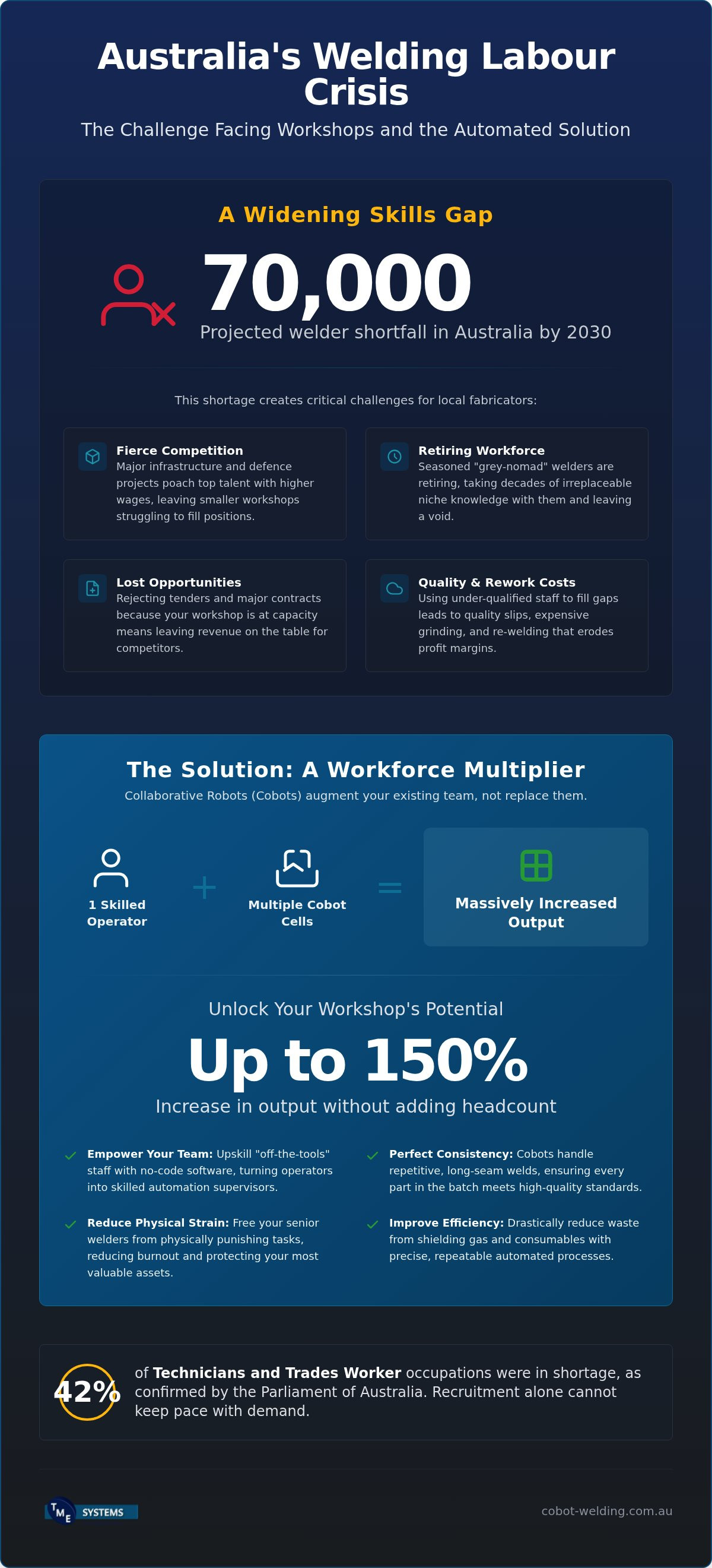

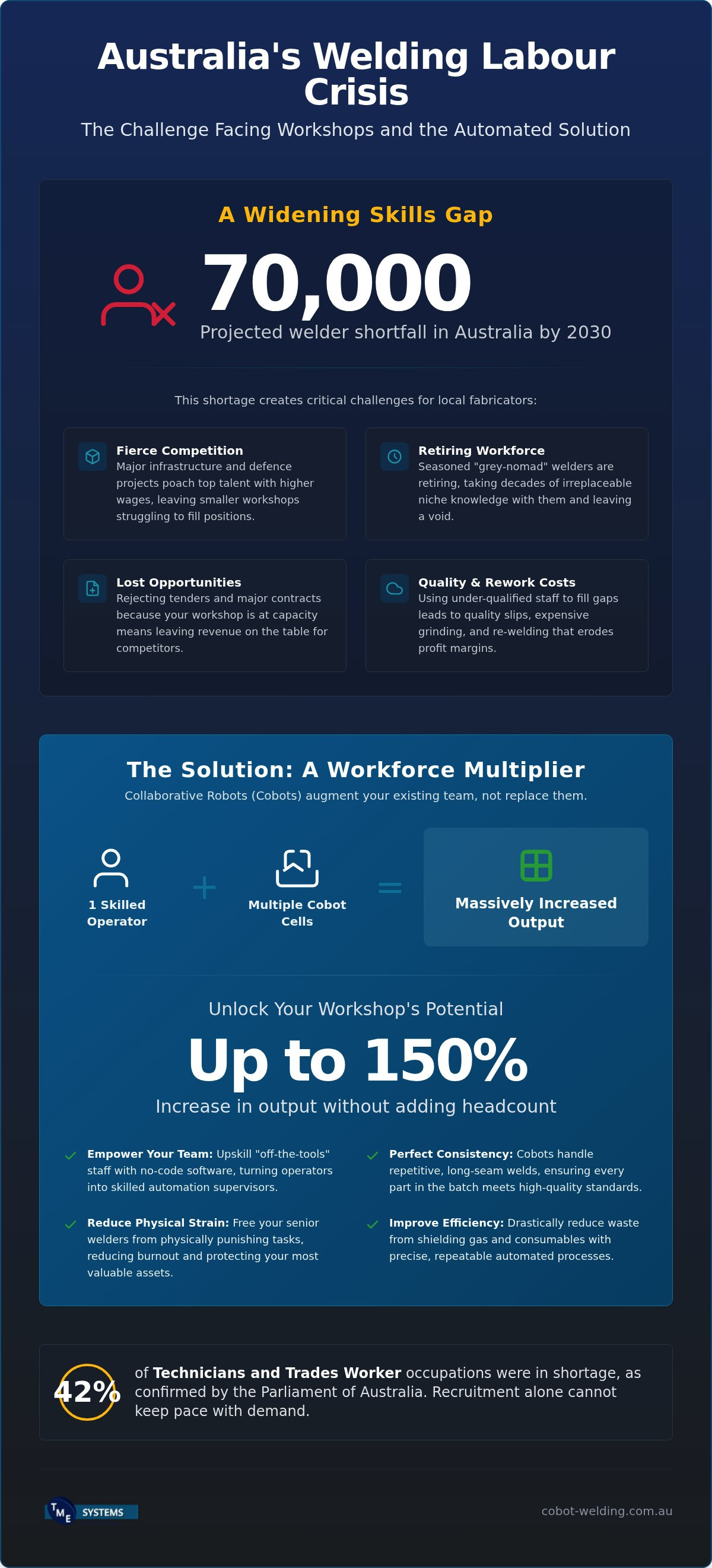
Did you know that Australia is projected to face a shortfall of 70,000 welders by 2030? It's a daunting figure that reflects the daily reality in workshops across the country, where finding and keeping skilled staff feels like an uphill battle. You've likely felt the pressure of rising labour costs or the frustration of watching a major infrastructure contract slip away because your floor is already at capacity. Searching for welding labour shortage solutions australia shouldn't just lead to more recruitment ads; it should lead to a more productive way of working.
We understand that your business relies on the grit and skill of your team, not just complex tech. That's why we're looking at how collaborative automation can act as a tool for your existing crew, rather than a replacement for them. This article explores how you can bridge the gap by upskilling "off-the-tools" staff to manage no-code cobot cells. We'll show you how to increase your output by up to 150% without adding to your headcount, ensuring your workshop maintains the high-quality standards your clients expect for every single batch.
Key Takeaways
- Understand why traditional recruitment alone won't bridge the 70,000-welder shortfall and how to pivot your workshop strategy toward high-output automation.
- Explore practical welding labour shortage solutions australia that allow you to scale production and secure major contracts without needing to find and hire more qualified tradespeople.
- Learn how no-code teaching software empowers your current team to manage robotic cells, effectively turning manual welders into skilled automation supervisors.
- Discover how to calculate the real ROI of cobots by analysing the cost-per-weld and the significant reduction in shielding gas and consumable waste.
- Get a clear roadmap for integrating your first cell, from identifying the best jobs for automation to booking an on-site mobile demo to prove the concept on your own parts.
The 2030 Welding Crisis: Why Recruitment Alone Won’t Save Your Workshop
Weld Australia has been ringing the alarm bells for some time now, projecting a massive shortfall of 70,000 welders by 2030. For the average workshop owner, this isn't just a distant data point; it's the reality of a floor that's often running at half-speed. You've likely felt the sting of the traditional apprenticeship model. While it remains the backbone of the trade, a four-year training cycle simply can't keep pace with the sudden surge in infrastructure and renewable energy projects hitting our shores. We're facing a situation where the demand for steel is rising, but the hands to join it are disappearing.
The solution isn't just about finding more people. It's about changing how we think about the work. Historically, Robot welding was seen as something reserved for massive car plants with six-figure budgets and full-time engineers. However, as we look for practical welding labour shortage solutions australia, the focus has shifted toward making automation accessible for the local fabricator. We can't hire our way out of this crisis, but we can certainly automate our way up, allowing our existing teams to produce more without the burnout.
The Competition for Skilled Labour
Smaller workshops are currently caught in a David and Goliath battle for talent. Major tier-one infrastructure projects and massive defence contracts are pulling the most experienced tradespeople away with higher wages and site allowances. This "poaching" doesn't just increase your labour costs; it disrupts your workshop flow. At the same time, our most seasoned "grey-nomad" welders are reaching retirement age. When they hang up their torches, they take decades of niche knowledge with them, leaving a void that a junior hire can't fill overnight. This loss of tribal knowledge is a quiet crisis that's making recruitment even harder.
The Cost of Inaction
The real price of this shortage shows up in your bottom line through missed opportunities. Every tender you reject because your team is at capacity is revenue left on the table for a competitor. There's also the hidden cost of rework. When you're forced to use under-qualified staff to fill gaps, quality often slips, leading to expensive grinding and re-welding that eats your margins. Finding effective welding labour shortage solutions australia is about protecting your reputation as much as your production schedule.
The 2026 skills gap in Australian manufacturing is the widening chasm between the complex technical requirements of modern defence and energy projects and the dwindling number of certified tradespeople available to execute them.
Collaborative Robots (Cobots) as a Workforce Multiplier
The Parliament of Australia confirms that 42 per cent of Technicians and Trades Worker occupations were in shortage, and for those searching for welding labour shortage solutions australia, the answer is increasingly found in collaborative technology. Collaborative robots, or cobots, represent a fundamental shift from the old industrial model. Traditional robots are fast but dangerous, requiring bolted-down cages and light curtains that eat up valuable floor space. Cobots are built with sensitive torque sensors in every joint. If they nudge an operator, they stop instantly. This safety profile allows them to sit right on a workbench next to a person, making them perfect for the compact layouts common in local fabrication shops.
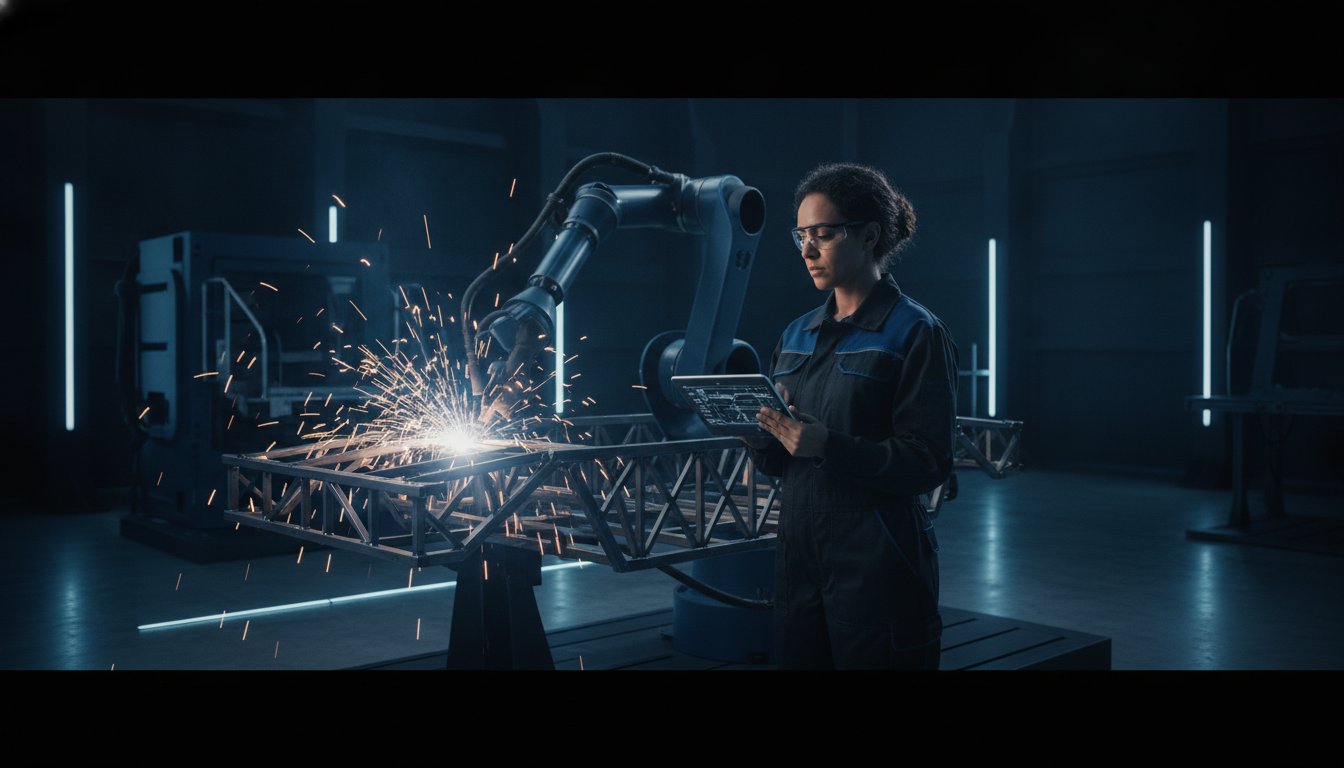
This technology acts as a workforce multiplier. Instead of one person producing one part at a time, a single technician can manage multiple collaborative robot welding cells. The machine handles the repetitive, long-seam welds with perfect consistency while the operator prepares the next jig or performs quality checks. It's about getting more out of your existing team without asking them to work harder or longer. By reducing the physical strain of maintaining a steady arc for hours on end, you're also protecting the health of your most valuable assets: your people.
Augmenting, Not Replacing, Your Staff
We often hear concerns that robots will take jobs, but the reality on the ground is the opposite. Cobots take over the repetitive and physically punishing tasks that often lead to burnout or injury. This frees your senior welders to focus on complex, high-value custom work that requires human intuition and problem-solving. It's helpful to view a cobot as a sophisticated power tool rather than a replacement worker. Much like the transition from manual drafting to CAD, this is simply the next step in empowering tradespeople to produce higher-quality work with less manual drudgery.
Versatility for Small Batch Runs
Most Australian SMEs don't run massive production lines; they handle a "high-mix, low-volume" workload. Cobots are uniquely suited to this because they don't require hours of complex coding to change jobs. You can swap out a jig and load a new program in minutes, making it viable to automate even small batches of 20 or 50 parts. Many systems are also mounted on mobile bases. This means you can wheel the robot to a large assembly rather than trying to move a heavy workpiece to a fixed station. If you want to see how this flexibility works in practice, you can view our range of integrated cells designed for local conditions.
Solving the Programming Barrier with No-Code Software
One of the biggest hurdles in adopting automation is the myth of the robot engineer. Many workshop owners believe they need to hire a computer scientist or a dedicated programmer to get a robot moving. This is simply not the case anymore. Modern no-code robot welding software has stripped away the complexity, allowing your best manual welders to "teach" the robot exactly how they want the weld to look. It turns a high-tech machine into a simple, accessible tool for the trade.
This is achieved via the "Lead-Through" method. Instead of typing lines of code, the operator physically takes the robot arm by the hand and guides it along the joint. As they move, the software records every nuance of the path, including the torch angle and travel speed. This approach is one of the most effective welding labour shortage solutions australia has available right now because it doesn't require years of retraining. Setup time for a new fabrication job drops from hours of programming to just a few minutes of manual guidance.
No-code software acts as a digital interpreter, capturing the high-resolution spatial coordinates of a hand-guided movement and instantly converting those points into a precise, repeatable path for the robot to follow.
Empowering the "Old Guard"
Experienced welders are often the most sceptical about new tech, but they are actually the best people to supervise a cobot. They understand the fundamentals of a good bead, from wire speeds to voltage settings. By using no-code interfaces, you're essentially capturing the "intellectual property" of your senior tradespeople and turning it into a digital asset. They set the parameters, and the robot executes them with robotic precision. This allows your veterans to scale their expertise across multiple stations without the physical toll of manual welding.
Training and Onboarding for 2026
While the technology is intuitive, on-site cobot welder training is vital for achieving an immediate ROI. It ensures your team feels confident and capable from day one. We are also seeing that younger apprentices engage much faster with these tech-enabled roles. It makes the trade more attractive to a generation that grew up with digital interfaces, helping you retain fresh talent. By combining traditional craftsmanship with modern tools, you create a workshop culture that is resilient enough to handle the 2030 shortfall.
Calculating the ROI of Automation in the Australian Context
When you look at the bottom line, the "Cost per Weld" is often where manual fabrication loses its edge in the current market. With labour rates rising and the constant threat of staff turnover, relying solely on manual processes makes it difficult to price tenders competitively. This is where looking for welding labour shortage solutions australia becomes a financial necessity. A collaborative cell provides a fixed cost of production. It doesn't require sick leave, superannuation at 11 per cent, or a four-week holiday, allowing you to project your margins with much higher accuracy.
The savings extend beyond just the hourly rate. Collaborative systems are remarkably efficient with consumables, often reducing wire and shielding gas waste by delivering the exact amount required for the joint every single time. When you combine these material savings with improved welding productivity, the payback period becomes very attractive. Industry data from 2026 suggests that for a single-shift operation, a MIG cobot cell typically pays for itself within 18 to 24 months. If you're running two shifts, that period can drop to as little as 10 to 14 months. Australian manufacturing businesses can also leverage various tax incentives or asset write-offs to further accelerate this return, making the initial investment even more manageable for small-to-medium enterprises.
Quality Control and Rework Reduction
Grinding and re-welding are some of the biggest hidden drains on workshop profitability. If a less experienced hire makes a mistake on a critical batch, the cost of rework can quickly wipe out the profit from that job. Cobots help you achieve "First Time Right" results by maintaining a consistent travel speed and arc length that a human simply can't match over an eight-hour shift. This standardises your quality across multiple shifts, ensuring that the last part of the day looks identical to the first without requiring constant supervision from your senior tradespeople.
Future-Proofing for Sovereign Capability
The push for sovereign capability in Australia means more work is staying local, but only for those who can prove they have the capacity to deliver. Scaling your business usually involves the risk of an unfillable headcount; however, automation allows you to grow your output without the hiring headache. It supports the "Made in Australia" brand by ensuring our local fabrication remains competitive against imports. To see how these numbers stack up for your specific shop, you can request a custom ROI analysis from our integration team.
Implementing Your First Cobot: The Path to Integration
Moving from manual fabrication to automation can feel like a massive leap, but the most successful transitions happen in stages. You don't need to overhaul your entire workshop on day one. The first step is identifying the "low-hanging fruit"—those simple, repetitive jobs that currently tie up your best welders for hours. These are the parts with long, straight seams or predictable circular welds. By automating these first, you see an immediate lift in capacity and a clear path toward more complex welding labour shortage solutions australia can provide for your business.
Once you've picked the right parts, the next step is a mobile welding robot demonstration. There is no substitute for seeing the technology work on your own parts, in your own environment, using your own jigs. This proof-of-concept stage de-risks the investment and proves the no-code software is as intuitive as it looks. From there, the integration process involves customising the cell to work with your existing power sources and ensuring the setup meets all Australian safety standards. Finally, operator training and safety certification ensure your team is ready to scale from a single cell to a fully automated workflow over time.
Choosing an Integration Partner
Success in automation depends heavily on the support you receive after the machine is bolted down. Local welding system integration is critical because it ensures you have access to technical support and spare parts right here in Australia. You need a partner who understands the local manufacturing landscape and can help you refine your processes as your production needs change. A local partner provides the reassurance that you aren't just buying a machine; you're gaining a long-term collaborator invested in your workshop's progress.
Next Steps for Your Workshop
Before making any big decisions, conduct a preliminary audit of your current welding workflow. Identify the bottlenecks and talk to your tradespeople about where they feel the most physical strain or boredom. Engaging your team early is the best way to ensure buy-in; when they see the cobot as a tool that makes their job easier, the transition becomes much smoother. This collaborative approach is one of the most effective welding labour shortage solutions australia has to offer, as it combines human expertise with robotic precision. To take the first step, book a mobile demo to see the no-code software in action at your site and see exactly how it fits into your production line.
Secure Your Workshop’s Future with Practical Automation
The projected shortfall of 70,000 welders by 2030 is a significant challenge, but it doesn't have to stall your workshop's growth. By shifting your focus toward accessible technology, you can find the welding labour shortage solutions australia needs to keep its manufacturing sector thriving. Collaborative automation isn't about replacing the skills of your tradespeople; it's about giving them the tools to produce more with less physical strain. This approach allows you to protect your margins and take on larger contracts without the constant stress of an unfillable headcount.
We provide turnkey collaborative robot welding cells that are built for the reality of the Australian shop floor. Our no-code teaching software ensures your existing team stays in control, while our Australian-based integration and support team provides the local expertise you need to succeed. Ready to see the difference for yourself? Book a Mobile Welding Robot Demonstration to see our No-Code Software in action on your own site. It's a straightforward way to see how automation can help your business stay ahead of the curve and remain competitive for years to come.
Frequently Asked Questions
How much does a welding cobot cost in Australia compared to a new hire?
A welding cobot is a capital investment that generally costs less than the total annual package of a senior tradesperson when you factor in wages, 11% superannuation, and payroll tax. While a new hire represents a recurring annual expense, the robot is a one-off cost that provides a fixed production rate for years. This makes it a sustainable financial choice for workshops struggling with rising labour costs and staff turnover.
Do I need a specialised engineer to program a collaborative welding robot?
No, you don't need a computer science degree or a dedicated engineer to operate these systems. Modern units use no-code teaching software that allows your existing manual welders to "teach" the robot by physically guiding the arm along the weld path. This approach keeps the trade expertise in the hands of your best welders rather than a programmer who may not understand the nuances of a good bead.
Can cobots handle MIG, TIG, and Plasma welding tasks?
Yes, collaborative systems are highly versatile and can be integrated with various power sources to perform MIG, TIG, and Plasma welding. While MIG is the most common for high-volume production, TIG cells are increasingly popular for precision work on thinner materials where consistent torch angles are vital. The robot ensures the same high-quality result regardless of the specific welding process being used.
Are collaborative welding robots safe to use without a safety cage?
Cobots are designed with sensitive torque sensors that stop the arm instantly upon contact, allowing them to work alongside humans without bulky safety cages. However, every installation must still undergo a risk assessment based on AS/NZS 4024 and ISO 15066 standards. You must also consider the welding arc, sparks, and fumes in your workshop layout to ensure a completely safe environment for your team.
What is the typical ROI period for an Australian fabrication business?
Most Australian fabrication businesses see a full return on investment within 18 to 24 months for a single-shift operation. If you run a two-shift workshop, this period can drop to between 10 and 14 months due to the increased throughput. This ROI is driven by the fact that automation is one of the most effective welding labour shortage solutions australia has for reducing rework and consumable waste.
How long does it take to train a manual welder to use a cobot?
A manual welder can typically learn the basics of operating a cobot in just a few hours. Because the no-code interface is intuitive, most operators are comfortable setting up their own programs and adjusting parameters by the end of their first day. This fast learning curve ensures that your workshop sees an immediate lift in productivity without months of downtime for retraining.
Can cobots work on aluminium and stainless steel as well as mild steel?
Yes, cobots are excellent for working with aluminium and stainless steel because they provide the consistent travel speed and heat control necessary for sensitive alloys. By automating the path, you reduce the risk of burn-through or distortion that often occurs during manual welding. This consistency is vital for maintaining the high-quality finishes required in the food, dairy, and marine industries.
What happens if my welding robot needs technical support or parts in Australia?
Choosing a local partner ensures you have direct access to Australian-based technical support and a ready supply of spare parts. You don't have to worry about international time zones or waiting weeks for components to clear customs. This local presence is essential for maintaining uptime and ensures that your investment continues to deliver results for the long term.