
What if your next "hire" wasn't a ticketed welder who might leave for a bigger firm, but a digital apprentice that pays for itself through increased throughput? It's a tough reality for many Australian workshops in 2026; you're facing a chronic shortage of skilled labour while rising overheads and electricity costs make it harder to quote competitively. You know you need to innovate to keep up with automated firms, but the thought of a massive upfront capital outlay is enough to stall any expansion plans.
We understand that a workshop floor is about practical results, not just shiny tech. In this guide, we'll show you how to use welding automation financing australia to scale your operations without risking your cash flow. You'll learn how to navigate the current financial landscape to secure a turnkey solution that aligns predictable monthly costs with your project revenue. We will break down how collaborative automation can empower your existing staff to do more, ensuring your workshop remains both profitable and resilient from day one.
Key Takeaways
- Learn why delaying automation during the 2026 skills shortage often results in higher costs from lost contracts than the monthly finance payment itself.
- Compare different welding automation financing australia structures, including chattel mortgages for ownership and finance leases for cash flow management.
- Calculate real-world ROI by looking beyond interest rates to include increased throughput and the reduction of rework and material scrap.
- Prepare your workshop by organising the specific financial and technical data that Australian lenders require for fabrication equipment approvals.
- Understand how no-code software from TME Systems Pty Ltd keeps the power in the hands of your ticketed welders, ensuring rapid uptime and immediate results.
The Business Case for Welding Automation in 2026
In 2026, the Australian fabrication industry is hitting a wall. We aren't just short a few ticketed welders; we are navigating the most acute skills shortage in our history. If you've had to turn down a major project recently because you didn't have the hands to finish it on time, you've felt the "Cost of Inaction" (COI). While it's tempting to wait until you have the cash in the bank to buy equipment outright, that delay is often far more expensive than the monthly cost of welding automation financing australia. Every contract lost to a larger, automated firm represents a missed opportunity to grow your reputation and your revenue.
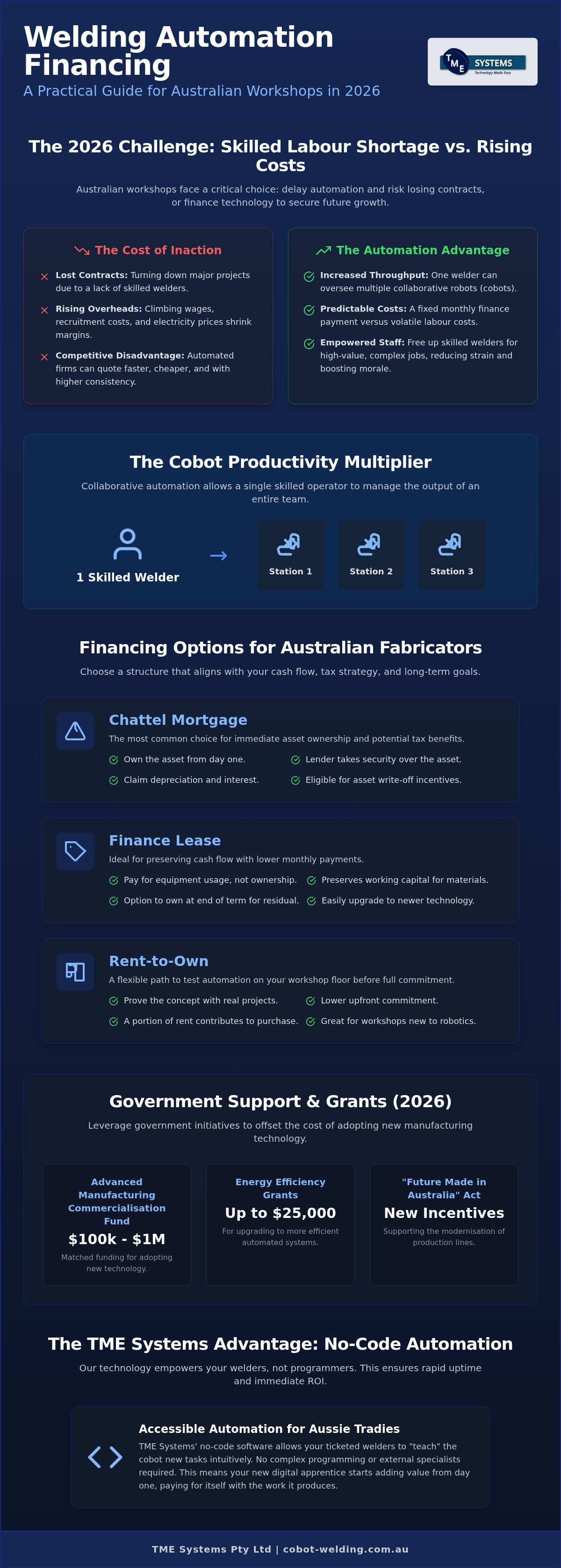
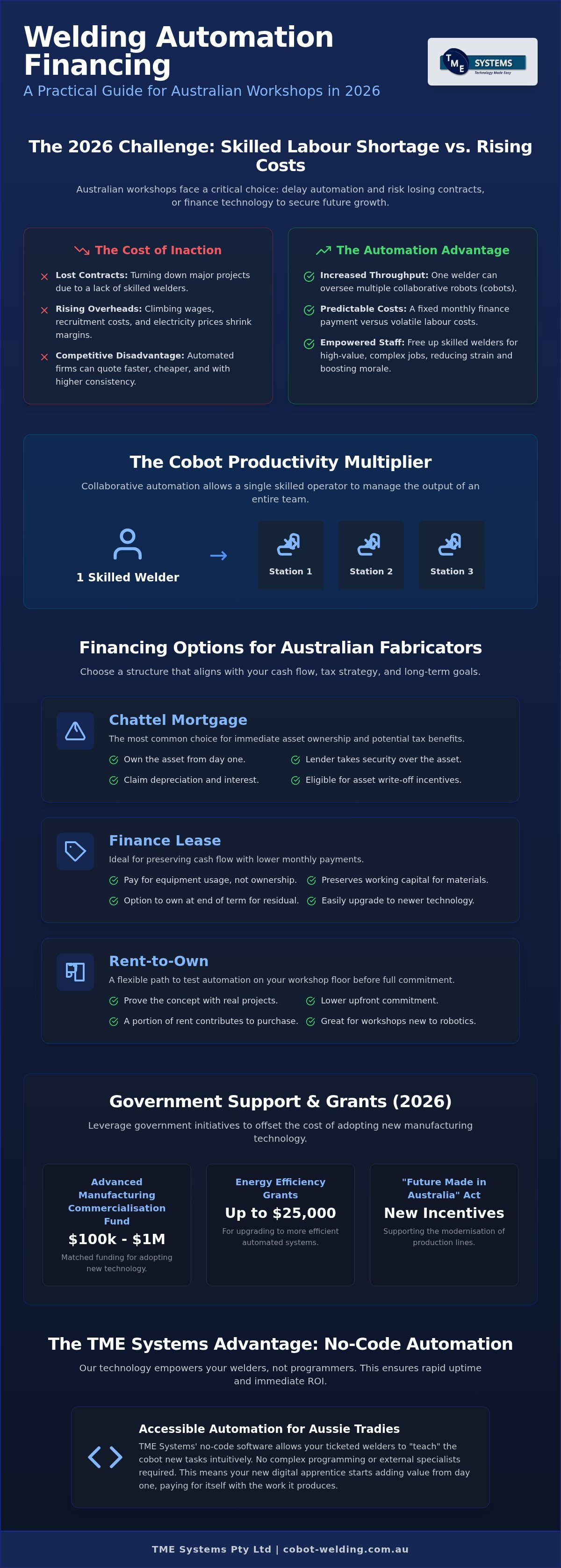
Traditional industrial robots were once reserved for massive automotive plants with huge budgets. Today, collaborative robots, or cobots, have changed the game for the local Aussie workshop. These systems allow one skilled welder to oversee three separate stations simultaneously. Instead of being stuck behind a mask for eight hours on repetitive runs, your best staff member becomes a production manager. This shift doesn't just increase your output; it ensures your workshop can take on more work with the team you already have on the floor.
Bridging the Labour Gap with Technology
Automation is a tool to support your people, not replace them. By using a cobot to handle repetitive, dull welds, you free up your staff to focus on the high-value, bespoke work that requires true craftsmanship. This approach significantly reduces the physical strain and RSI associated with high-volume production, which helps keep your experienced welders on the tools for longer. Financing these systems acts as a practical "labour hedge." While wages and recruitment costs continue to climb, your monthly finance payment remains fixed and predictable. It's a steady way to manage your overheads while scaling your capacity.
From Capital Expense to Operational Advantage
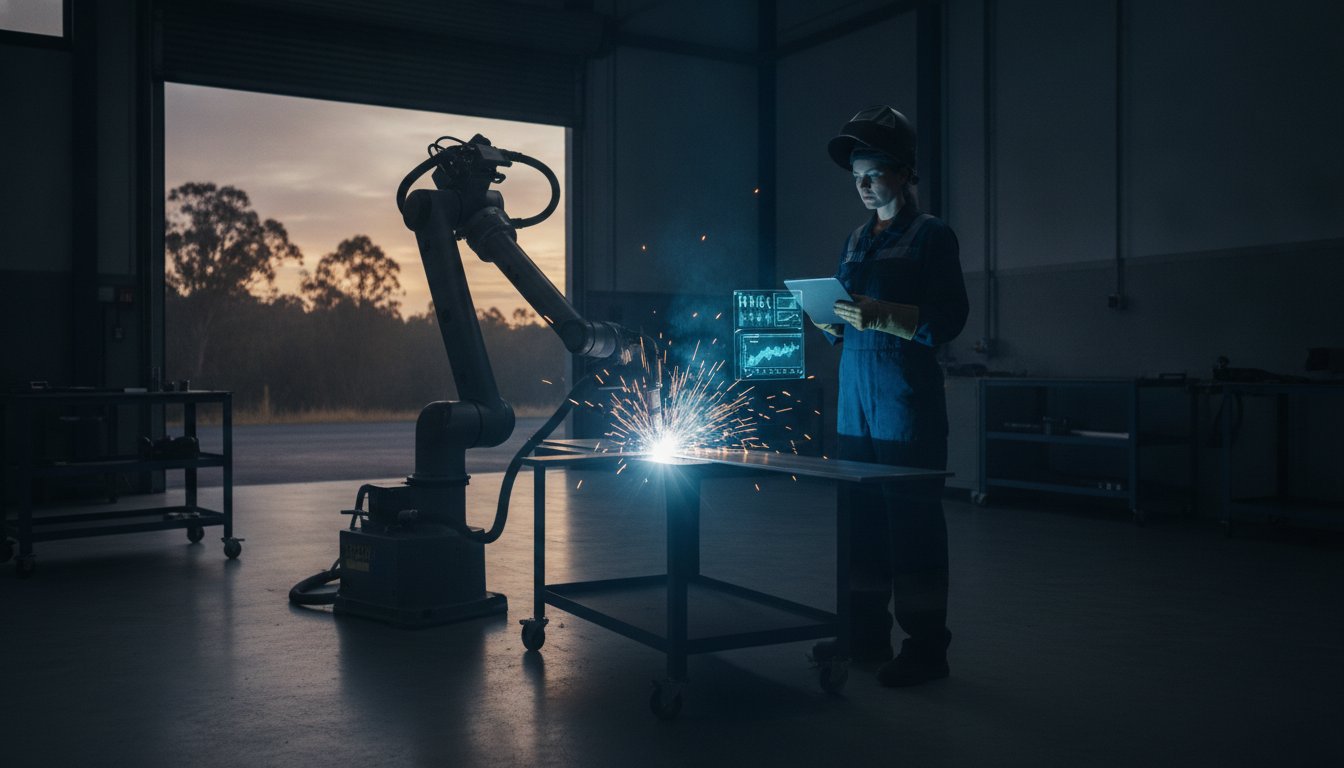
It's time to shift the mindset. Instead of viewing a welding cell as a scary capital expense, think of it as a digital apprentice with a fixed monthly "wage" that never calls in sick. Moving to a hybrid fabrication model in 2026 is the most effective way to stay competitive against firms that have already embraced technology. To make this transition work, you need systems that your team can actually use. The role of no-code robot welding software is critical here. It ensures rapid uptime by allowing your current welders to "teach" the machine without needing an external programmer. This accessibility means the machine starts paying for itself through project revenue almost immediately.
Understanding Financing Options for Australian Fabricators
Finding the right path for welding automation financing australia depends on your long-term goals and current tax position. Most Aussie fabricators choose a Chattel Mortgage because it provides immediate ownership from the outset. This structure is particularly effective in 2026 as it often allows businesses to take advantage of asset write-off incentives, reducing your taxable income while the machine starts its first shift. You own the asset, and the lender takes a mortgage over it as security.
If you prefer to keep your monthly outlays as low as possible, a Finance Lease might be the better fit. You pay for the use of the equipment over a set term, which preserves your cash flow for materials and wages. At the end of the lease, you can often choose to pay a residual amount to own the machine or upgrade to a newer model. For those still testing the waters of robotic integration, Rent-to-Own models offer a flexible middle ground. This allows you to prove the concept on your shop floor before committing to a full purchase.
Current data on Australian manufacturing sector performance shows that while headwinds remain, domestic production is finding its feet through smarter technology. To support this, several government grants are active in 2026. The Advanced Manufacturing Commercialisation Fund provides matched funding between $100,000 and $1 million for businesses adopting new tech. Additionally, Energy Efficiency Grants offer up to $25,000 for workshops upgrading to more efficient automated systems. While the Modern Manufacturing Initiative is currently closed, the "Future Made in Australia" Act provides new incentives for those modernising their production lines.
Choosing the Right Structure for Your Cash Flow
Interest rates for prime business borrowers in August 2026 are starting from approximately 7.49% p.a. for fixed equipment finance. While fixed rates offer certainty, some workshops opt for variable structures if they expect market conditions to shift. You should also consider "seasonal" payment structures if your fabrication work peaks during specific months. It is vital to include on-site cobot welder training in your finance bundle. Ensuring your team knows how to operate the cell from day one is the fastest way to see a return on your investment. If you want to see how this technology fits into your specific workflow before talking to a lender, a mobile demonstration can provide the on-site proof of concept you need.
Asset Life and Depreciation
A collaborative robot is a long-term asset with a lifespan that often exceeds the finance term. In 2026, Australian SMEs can still access specific tax incentives for small business asset write-offs, though you should always verify the latest thresholds with your accountant. Understanding the residual value is important when you are planning your workshop's future. By aligning the finance term with the expected peak productivity of the machine, you ensure the equipment pays for itself well before it needs a major service or technical refresh.
Calculating ROI: Looking Beyond the Monthly Payment
When evaluating welding automation financing australia, it's easy to get fixated on the monthly repayment figure. However, the real value lies in the "per weld" cost analysis. While a manual welder might be faster on a single complex joint, a cobot provides consistent throughput hour after hour without fatigue. By improving welding productivity with cobots, you're effectively lowering the production cost of every part that leaves your floor. Precision is a massive factor here. Machine-led pathing eliminates the human error that leads to expensive rework and scrap material, saving you thousands in wasted steel and aluminium over a typical year.
The "No-Code" software advantage is perhaps the most significant ROI driver in 2026. In the past, industrial automation often required a dedicated robotic programmer, a role that can cost upwards of $100,000 annually in the current market. By keeping the programming in-house with your existing ticketed welders, you remove this massive overhead entirely. Your team remains in control, and the machine becomes a practical tool they use rather than a complex system that requires external support every time a part changes.
The Speed of Integration
ROI is heavily dependent on "Time to First Arc." The longer a system sits idle during a complex setup, the more it costs your business in lost opportunity. This is why turnkey collaborative robot welding cells are becoming the standard for Australian SMEs. They are designed for rapid deployment. Unlike custom-built rigs that might take months to commission, these cells often start producing billable work within days of arriving. If you're unsure about how the numbers stack up for your specific workshop, booking a mobile welding robot demonstration allows you to validate the throughput on your own parts before you sign a finance agreement.
Hidden Savings: Energy and Consumables
Beyond labour, automated systems offer significant savings in consumables. Path optimisation software ensures that gas and wire are only used exactly where needed, which some industry professionals report can lead to a noticeable reduction in wastage. Modern cobots are also designed with energy efficiency at the core, drawing significantly less power than legacy industrial systems. As the industry addresses workforce challenges and opportunities, it's clear that automation also helps manage the rising cost of PPE and extraction maintenance. Less smoke and spatter means a cleaner, safer environment and lower ongoing maintenance costs for your workshop's ventilation systems.
Preparing Your Workshop for Financed Automation
Before you apply for welding automation financing australia, you need to have your books in order. Australian lenders typically look for at least two years of profitable trading and a clear plan for how the equipment will generate revenue. They don't just want to see your balance sheet. They want to see that you've accounted for the total cost of ownership, including the peripheral gear and training. Working with welding system integration specialists can help here. They provide the technical documentation and project timelines that give banks the confidence to sign off on the loan.
Don't wait for the delivery truck to arrive before you check your workshop's infrastructure. Most collaborative cells require a standard 240V or 415V (3-phase) supply depending on the specific welder integrated. You also need a level floor and enough space for the operator to move safely around the cell. Getting your lead welders involved early creates a "Transition Team" that understands the technical needs of the machine. When your best tradespeople feel ownership over the new tech, the onboarding process is much smoother and more productive.
Step-by-Step Finance Readiness
- Step 1: Perform a "Workload Audit" to identify the repetitive jobs most suited for cobots.
- Step 2: Secure a firm quote that includes the cell, no-code software, and operator training.
- Step 3: Consult with your accountant regarding tax-effective debt structures for 2026.
- Step 4: Book an on-site demo to ensure your staff are ready for the change before the finance is finalised.
If you're ready to see how a cobot handles your specific production runs, book a mobile demonstration today to prove the concept on your own workshop floor.
Safety and Compliance Considerations
Collaborative robots are designed to work alongside humans, but they still fall under Australian safety standards such as ISO/TS 15066. Your finance plan should account for any necessary safety curtains or area scanners required for your specific application. One major benefit of cobots is that they often require less expensive physical caging than traditional industrial robots. This keeps your initial setup costs lower and keeps your floor plan flexible. Finally, ensure your financed asset is fully insured for the workshop environment before it is commissioned to protect your investment from day one.
The TME Systems Pty Ltd Approach: Accessible Automation for Aussie Tradies
At TME Systems Pty Ltd, we believe that the most successful automation projects are those where the technology feels like a natural extension of the welder's hand. Many shops hesitate to innovate because they fear losing the human touch or becoming beholden to complex IT systems. We address this by specialising in solutions that prioritise ease of use and floor-level practicality. Our no-code teaching software ensures that your ticketed welders remain the decision-makers on the floor. They set the parameters, they refine the paths, and they maintain the quality standards your customers expect without needing to learn a line of computer code.
Securing welding automation financing australia is often the biggest hurdle for a growing job shop. We've spent years building relationships with specialist lenders who understand the unique value of a collaborative welding cell. Unlike general commercial banks that might view a cobot as a high-risk tech purchase, our finance partners see it as a primary production asset. This industry-specific knowledge often leads to more favourable terms and a faster approval process, allowing you to get the machine on the floor and producing billable parts sooner. Success stories from across the country show that local job shops are using these systems to scale rapidly, with some doubling their daily output on standard components within the first few months of installation.
The "Practical Mentor" Philosophy
We don't just drop off a machine and leave you to figure it out. TME Systems Pty Ltd acts as a practical mentor, training your staff to transition from manual welders to confident cobot operators. This shift is about more than just pressing buttons; it's about understanding how to optimise the machine for high-mix, low-volume production. Our software is designed to adapt to your existing workshop jigs and workflows, ensuring that you don't have to rebuild your entire operation to accommodate the new technology. We also provide ongoing firmware updates to ensure your financed asset remains at the cutting edge of performance.
Starting Your Automation Journey
The first step is always about de-risking the transition for your business. Our mobile demo system allows you to test the technology on your own workshop floor using your own production parts. This provides a clear, hands-on proof of concept before any financial commitments are made. Within the first 30 days of automated production, most workshops find that their throughput increases significantly as the "digital apprentice" takes over the repetitive runs. To start a pragmatic discussion about your workshop’s future, reach out to the team at TME Systems Pty Ltd for an on-site demonstration and a realistic assessment of your automation potential.
Future-proofing Your Workshop with Confidence
The landscape of Australian manufacturing is changing, and staying competitive in 2026 requires more than just traditional grit. By moving away from the barrier of a massive capital outlay and embracing a structured finance model, you secure the capacity to grow without overextending your cash flow. It is a strategic shift that turns the pressure of a labour shortage into an opportunity for workshop innovation. When you treat technology as a long-term partner, you empower your best people to focus on the complex fabrication work that truly builds your reputation.
Navigating welding automation financing australia is the most practical way to bring the latest technology onto your floor today. TME Systems Pty Ltd provides the local, Australian-owned support you need to ensure this transition is seamless and profitable. With no-code software designed for tradespeople rather than programmers, we help you achieve proven productivity gains even in high-mix, low-volume environments. Ready to take the next step? You can Book a Mobile Welding Robot Demonstration to see the ROI in your own workshop and discover how a digital apprentice can transform your business for the better.
Frequently Asked Questions
Can I finance the software and training along with the welding robot?
Yes, you can bundle these costs into a single agreement. Most specialist lenders understand that a collaborative cell is only effective with the right software and operator training. Including these in your welding automation financing australia package ensures your monthly repayment covers the entire turnkey solution. This prevents unexpected out-of-pocket costs and ensures the machine is productive from the very first day it arrives on your workshop floor.
Do I need to be a large company to qualify for welding automation finance in Australia?
No, you don't need to be a large corporation to qualify for equipment finance. In 2026, the majority of businesses adopting collaborative technology are small-to-medium job shops. Lenders typically look for a stable trading history of at least two years and a clear business case for the equipment. As long as you can demonstrate how the machine will improve your throughput, many finance options are accessible.
What is the typical interest rate for industrial equipment finance in 2026?
Fixed interest rates for prime business borrowers in August 2026 typically start from approximately 7.49% p.a. for equipment finance. These rates can vary based on your workshop's credit profile and the specific structure of the loan, such as a chattel mortgage or hire purchase. It is best to consult with a specialist broker who understands the manufacturing sector to find a competitive rate that matches your current financial position.
Can I include a mobile demonstration in my initial consultation?
Yes, a mobile demonstration is a standard part of our initial consultation process. We bring the system to your workshop so you can see it handle your specific parts and jigs. This de-risks the investment by providing a practical proof of concept on your own floor. It also gives your lead welders a chance to use the no-code software before any finance documents are signed.
How does the instant asset write-off work for robotic welding cells?
The instant asset write-off rules in 2026 allow eligible Australian small businesses to deduct the full cost of assets like robotic welding cells from their taxable income. While the specific thresholds are updated periodically, these incentives are designed to encourage workshops to modernise their equipment. You should consult with your accountant to confirm how these rules apply to your business's turnover and the specific timing of your purchase.
What happens if my business needs change during the finance term?
If your workshop's requirements shift during the finance term, you have several options to consider. Many finance leases and chattel mortgages offer the flexibility to refinance or trade in the equipment for a newer model. Because collaborative robots have a high residual value and a long operational lifespan, they remain attractive assets if you need to upgrade your capacity or shift toward a different type of fabrication work.
Is it better to lease or buy a welding cobot for a small job shop?
Choosing between a lease and a chattel mortgage depends on your workshop's cash flow and tax strategy. A lease often provides lower monthly outlays and keeps the equipment off your balance sheet, which is useful for maintaining liquidity. Buying through a chattel mortgage gives you immediate ownership and potential tax benefits through depreciation. For many small job shops, the choice comes down to whether you prioritise long-term asset ownership.
Do lenders require a large deposit for robotic welding automation?
Lenders often provide welding automation financing australia with low or even zero deposit for established fabrication businesses. If your workshop has a strong credit history and consistent revenue, you may be able to finance 100% of the equipment cost. This allows you to preserve your working capital for materials and wages while the new automated system begins generating its own ROI. Always check with your lender for their specific security requirements.